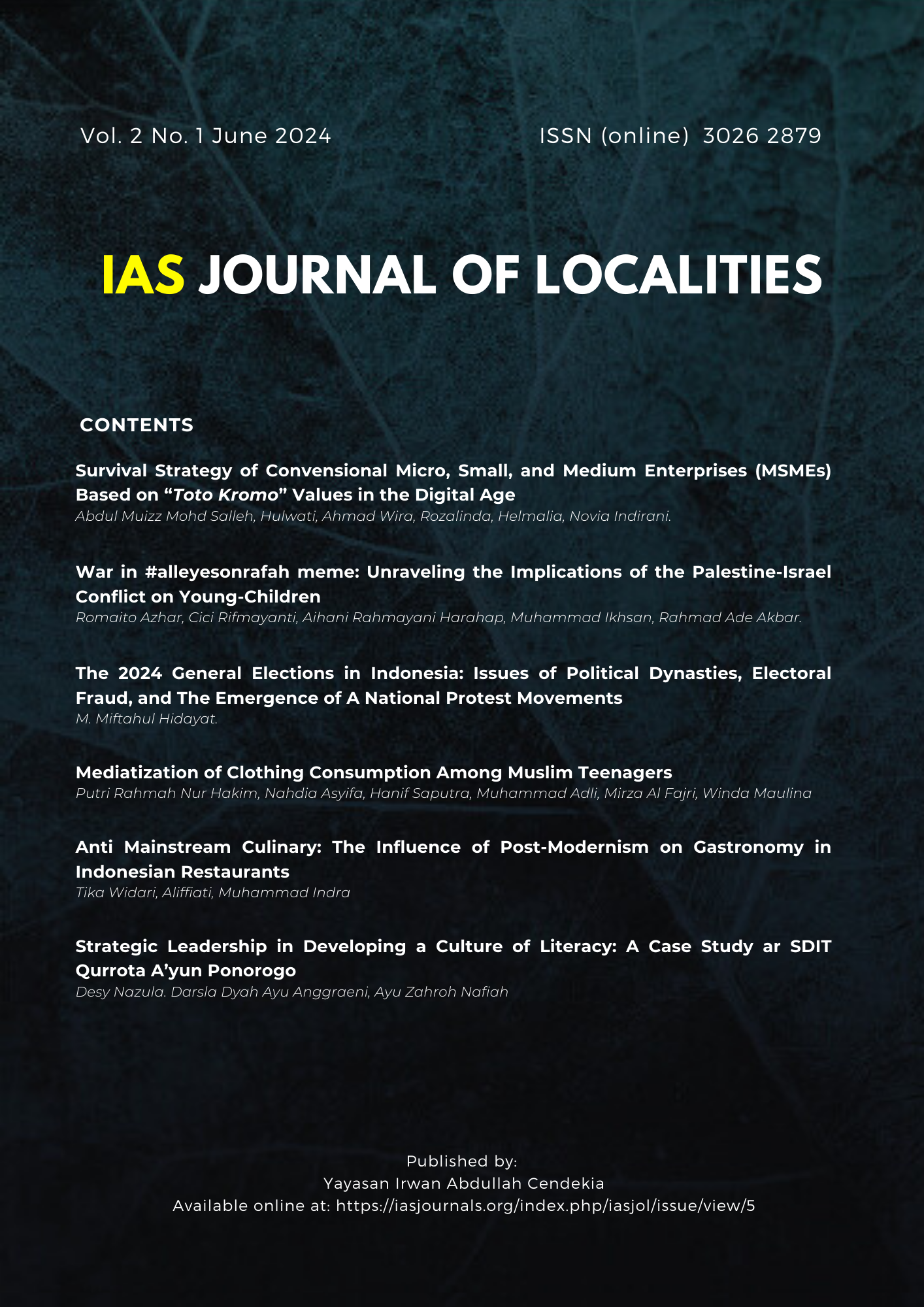
War in #alleyesonrafah meme: Unraveling the Implications of the Palestine-Israel Conflict on Young-Children
DOI:
https://doi.org/10.62033/iasjol.v2i1.45Keywords:
#alleyesonrafah, War, Conflict, Palestine-Israel, Young childrenAbstract
The dissemination of Palestinian conflict issues on Instagram social media, goes beyond simply being a form of informative communication practice, it also describes the situation and latent dangers of the conflict’s implications for vulnerable groups. However, this context tends to be neglected in scientific discussions. This study also focuses on explaining and reflecting on the latent dangers of the implications of the Palestine-Israel conflict for children as a vulnerable group on Instagram. By using a qualitative descriptive case study approach, this study shows three important findings. First, the latent danger of the Palestinian-Israeli conflict, aside from claiming the lives of many children who were victims, quite a few children also lost their relatives and friends who were in the conflict area. Second, the latent danger of the Palestinian-Israeli conflict, aside depriving depriving children of their right to get a decent place to live, it has also destroyed the living environment in refugee camps for children in conflict areas. Third, the latent danger of the Palestinian-Israeli conflict, aside from causing children to lose their fathers and mothers, also causes quite a few of children to lose their entire family members in conflict areas. This study also recommends the importance of discussing the issues of the Palestinian-Israeli conflict which are disseminated on Instagram by using more varied hashtags.
References
Abu-Ayyash, S. (2024). Representations of Palestinian Culture in the Digital Public Sphere: A Semiotic Analysis of the Thobe and the Keffiyeh. Social Media + Society, 10(1), 1–14. https://doi.org/10.1177/20563051231224274
Adriany, V., Aprilianti, L., & Kurniati, E. (2021). Indonesian street children’s negotiation of play. Contemporary Issues in Early Childhood, 22(4), 359–373. https://doi.org/10.1177/14639491211061618
Airlangga PH, A. R., Saputri, W. A., & Nurhakim, P. R. (2024). Socio-religious behavior on consumption pattern during Israel and Palestine conflict in Muslim society. IAS Journal of Localities, 1(2), 138–152. https://doi.org/10.62033/iasjol.v1i2.22
Alqaisiya, W. (2023). Beyond the contours of Zionist sovereignty: Decolonisation in Palestine’s Unity Intifada. Political Geography, 103(1), 1–11. https://doi.org/10.1016/j.polgeo.2023.102844
Appel, G., Grewal, L., Hadi, R., & Stephen, A. T. (2020). The future of social media in marketing. Journal of the Academy of Marketing Science, 48(1), 79–95. https://doi.org/10.1007/s11747-019-00695-1
Bürgin, D., Anagnostopoulos, D., Anagnostopoulos, D., Doyle, M., Eliez, S., Fegert, J., Fuentes, J., Hebebrand, J., Hillegers, M., Karwautz, A., Kiss, E., Kotsis, K., Pejovic-Milovancevic, M., Räberg Christensen, A. M., Raynaud, J.-P., Crommen, S., Çetin, F. Ç., Boricevic, V. M., Kehoe, L., … Fegert, J. M. (2022). Impact of war and forced displacement on children’s mental health—multilevel, needs-oriented, and trauma-informed approaches. European Child & Adolescent Psychiatry, 31(6), 845–853. https://doi.org/10.1007/s00787-022-01974-z
Cameron, N. (2023). Child growth and armed conflict. Annals of Human Biology, 50(1), 301–307. https://doi.org/10.1080/03014460.2023.2224059
Carpiniello, B. (2023). The Mental Health Costs of Armed Conflicts—A Review of Systematic Reviews Conducted on Refugees, Asylum-Seekers and People Living in War Zones. International Journal of Environmental Research and Public Health, 20(4), 1–16. https://doi.org/10.3390/ijerph20042840
Cinelli, M., De Francisci Morales, G., Galeazzi, A., Quattrociocchi, W., & Starnini, M. (2021). The echo chamber effect on social media. Proceedings of the National Academy of Sciences, 118(9), 1–8. https://doi.org/10.1073/pnas.2023301118
De Nutte, L., De Haene, L., & Derluyn, I. (2024). Interconnections between children’s upbringing, camps, and post‐war villages: caregivers’ lived experiences in northern Uganda. Disasters, 48(3), e12624. https://doi.org/10.1111/disa.12624
Docherty, M., Decrop, R., McManamon, B., Boxer, P., Dubow, E. F., & Huesmann, L. R. (2023). Exposure to violence predicts callous‐unemotional traits and aggression in adolescence in the context of persistent ethnic‐political conflict and violence. Aggressive Behavior, 49(6), 655–668. https://doi.org/10.1002/ab.22103
Fernando, H., & Larasati, Y. G. (2023). Melampaui dari Sebuah Simbol Semangka: Memahami Konflik Palestina-Israel dalam Instagram. Religi:Jurnal Studi Agama-Agama, 19(2), 205–226. https://ejournal.uin-suka.ac.id/ushuluddin/Religi/article/view/4486
Fernando, H., & Larasati, Y. G. (2024). Rekonstruksi Figur Perempuan dalam #metoo di Instagram. Jurnal Komunikasi, 18(2), 151–168. https://doi.org/10.20885/komunikasi.vol18.iss2.art3
Fernando, H., Larasati, Y. G., Abdullah, I., Afriadi, D., Marsaban, A., Nurasih, W., & Morin, L. (2023). The Dual Burden of Child Sexual Abuse: Victim Experiences and Law Implementation Gaps. Jurnal Hukum Novelty, 14(2), 154–169. https://doi.org/10.26555/novelty.v14i2.a27059
Fernando, H., Larasati, Y. G., & Cahyani, N. (2023). Being #wanitasalihah: Representations of salihah women on TikTok. IAS Journal of Localities, 1(1), 1–15. https://doi.org/10.62033/iasjol.v1i1.8
Fernando, H., Larasati, Y. G., Wuysang, J. M., Florika, V. T., Rifmayanti, C., Morin, L., & Akbar, R. A. (2024). The Commodification of Children as Endorsements on Instagram Social Media. Elegentia: Journal of Arts, Media, and Technology, 1(1), 43–57. https://iasjournals.org/index.php/elegentia/article/view/56
Gaber, Y. A., Al-Sanabani, R., Annuzaili, D. A., Al-danakh, A., & Ling, L. C. (2022). Research progress of health care in Yemeni children during the war: review. Primary Health Care Research & Development, 23, 1–16. https://doi.org/10.1017/S1463423622000421
Galuh Larasati, Y., Fernando, H., Jubba, H., Abdullah, I., Darus, M. R., & Iribaram, S. (2023). Past preferences informing future leaders for Indonesian 2024 general elections. Cogent Social Sciences, 9(1), 1–14. https://doi.org/10.1080/23311886.2023.2229110
Garry, S., & Checchi, F. (2020). Armed conflict and public health: into the 21st century. Journal of Public Health, 42(3), 287–298. https://doi.org/10.1093/pubmed/fdz095
Golbeck, J. (2019). Dogs Good, Trump Bad. Proceedings of the 10th ACM Conference on Web Science, 125–129. https://doi.org/10.1145/3292522.3326009
Goyanes, M., Borah, P., & Gil de Zúñiga, H. (2021). Social media filtering and democracy: Effects of social media news use and uncivil political discussions on social media unfriending. Computers in Human Behavior, 120, 1–9. https://doi.org/10.1016/j.chb.2021.106759
Gramsci, A. (1992). Prison Notebooks: Volume I. In Columbia University Press. Columbia University Press. https://cup.columbia.edu/book/volume-1-prison-notebooks/9780231060837
Grover, P., Kar, A. K., & Dwivedi, Y. (2022). The evolution of social media influence - A literature review and research agenda. International Journal of Information Management Data Insights, 2(2), 1–13. https://doi.org/10.1016/j.jjimei.2022.100116
Haque, M., Muniruzzaman, M., & Haque, I. E. (2022). The Changing Pattern of Intimate Relationship and the Influence of Technology on Youth in Socio-Cultural Attachment of Bangladesh. International Journal of Social Science Research and Review, 5(3), 52–66. https://doi.org/10.47814/ijssrr.v5i3.195
Hasler, B. S., Leshem, O. A., Hasson, Y., Landau, D. H., Krayem, Y., Blatansky, C., Baratz, G., Friedman, D., Psaltis, C., Cakal, H., Cohen-Chen, S., & Halperin, E. (2023). Young generations’ hopelessness perpetuates long-term conflicts. Scientific Reports, 13(1), 1–13. https://doi.org/10.1038/s41598-023-31667-9
Hauter, J. (2023). Forensic conflict studies: Making sense of war in the social media age. Media, War & Conflict, 16(2), 153–172. https://doi.org/10.1177/17506352211037325
Karadžić, T., & Ristić, A. J. (2022). Epilepsy on social media in Serbian, Croatian, and Bosnian languages. Epilepsy & Behavior, 136, 1–5. https://doi.org/10.1016/j.yebeh.2022.108912
Kim, S. J. (2023). Computers in Human Behavior The role of social media news usage and platforms in civic and political engagement : Focusing on types of usage and platforms. Computers in Human Behavior, 138(August 2022), 1–10. https://doi.org/10.1016/j.chb.2022.107475
Križić-Roban, S. (2021). Prolongirana trauma: Domovinski rat i suvremena hrvatska fotografija. Život Umjetnosti, 108, 22–43. https://doi.org/10.31664/zu.2021.108.02
Larasati, Y. G., & Abdullah, I. (2023). Social Pressure : Motif dan Alasan Anak Melakukan Aborsi. Community : Pengawas Dinamika Sosial, 9(2), 153–170. https://doi.org/10.35308/jcpds.v9i2.7719
Mahamid, F. A. (2020). Collective Trauma, Quality of Life and Resilience in Narratives of Third Generation Palestinian Refugee Children. Child Indicators Research, 13(6), 2181–2204. https://doi.org/10.1007/s12187-020-09739-3
Mann, L., & Janis, I. (2021). Conflict Theory of Decision Making and the Expectancy-Value Approach. In Expectations and Actions (pp. 341–364). Routledge. https://doi.org/10.4324/9781003150879-19
Miles, M. B., & Huberman, A. M. (2014). Qualitative data analysis: A methods sourcebook (J. Saldana (ed.); 3rd ed.). SAGE Publication. https://books.google.co.id/books?id=3CNrUbTu6CsC&printsec=frontcover&hl=id&source=gbs_ge_summary_r&cad=0
Mohajerani, A., Baptista, J., & Nandhakumar, J. (2015). Exploring the role of social media in importing logics across social contexts: The case of IT SMEs in Iran. Technological Forecasting and Social Change, 95, 16–31. https://doi.org/10.1016/j.techfore.2014.06.008
Nabulsi, J. (2023). A politics of conviction: The refusal of colonial carcerality in Palestinian graffiti. Human Geography, 16(3), 370–376. https://doi.org/10.1177/19427786231200717
Nguyen, A. J., Roe, J., Jeharsae, R., Samankasikorn, W., & Bullock, L. (2024). Exploring the Daily Lives and Well-Being of Orphaned Adolescents Affected by the Armed Conflict in Thailand’s Deep South. Journal of Adolescent Research, 39(3), 639–666. https://doi.org/10.1177/07435584211043294
Nurasih, W., Latifah, A., & Mohamed, A. H. I. (2023). Spirituality transformation from metaphysical to metaverse. IAS Journal of Localities, 1(2), 114–123. https://doi.org/10.62033/iasjol.v1i2.17
Posylnyi, I. (2024). The Soviet Pillar of Belonging. Communist and Post-Communist Studies, 57(2), 112–134. https://doi.org/10.1525/cpcs.2023.2002005
Procter, C., Pontalti, K., Hart, J., & Alruzzi, M. (2024). Conceptualising and challenging child neglect in humanitarian action: Protecting displaced children in Jordan and Palestine. Child Abuse & Neglect, 147, 106539. https://doi.org/10.1016/j.chiabu.2023.106539
Rahim, M. A. (2017). Managing Conflict in Organizations. In Managing Conflict in Organizations (4th ed.). Routledge. https://doi.org/10.4324/9780203786482
Sajir, Z., & Aouragh, M. (2019). Solidarity, social media, and the “refugee crisis”: Engagement beyond affect. International Journal of Communication, 13, 550–577. https://ijoc.org/index.php/ijoc/article/view/9999
Salazar Flórez, J. E., Humberto Montoya, W., & Giraldo Cardona, L. S. (2024). Risk Factors Associated With Bullying in Context of a Territory Exposed to Armed Conflict: A Cross-sectional Study. Journal of Interpersonal Violence, 39(11–12), 2552–2575. https://doi.org/10.1177/08862605231220026
Taika Salo Devries, J. (2024). Navigating Conflict. Bulletin - Association of Canadian Map Libraries and Archives (ACMLA), 173, 19–36. https://doi.org/10.15353/acmla.n173.5691
Thiessen, C., & Darweish, M. (2018). Conflict resolution and asymmetric conflict: The contradictions of planned contact interventions in Israel and Palestine. International Journal of Intercultural Relations, 66, 73–84. https://doi.org/10.1016/j.ijintrel.2018.06.006
Varvin, S. (2023). Psychoanalysis and the third position: social upheavals and atrocity. The International Journal of Psychoanalysis, 104(3), 574–584. https://doi.org/10.1080/00207578.2023.2213528
Veronese, G., Mahamid, F., Bdier, D., Obaid, H., & Cavazzoni, F. (2024). The development and validation of the Palestinian children’s traumatic events checklist in a war-torn environment. BMC Psychiatry, 24(1), 1–11. https://doi.org/10.1186/s12888-024-05731-1
Węcel, K., Stróżyna, M., Szmydt, M., & Abramowicz, W. (2024). The Impact of Crises on Maritime Traffic: A Case Study of the COVID-19 Pandemic and the War in Ukraine. Networks and Spatial Economics, 24(1), 199–230. https://doi.org/10.1007/s11067-023-09612-0
Widari, T., Aliffiati, & Indra, M. (2023). Fast fashion: Consumptive behavior in fashion industry Generation Z in Yogyakarta. IAS Journal of Localities, 1(2), 104–113. https://doi.org/10.62033/iasjol.v1i2.18
Zachs, F. (2019). Children in war time: the first pupils of the Syrian (Schneller) orphanage in Jerusalem 1860–1863. Middle Eastern Studies, 55(6), 958–973. https://doi.org/10.1080/00263206.2019.1616546
Zhovnir, M. M., & Leshchenko, T. O. (2023). Visual Language of Multimodal Text: Pragmatics of Color (The Russian-Ukrainian War in the Covers of World Publications). Alfred Nobel University Journal of Philology, 2(26/2), 108–126. https://doi.org/10.32342/2523-4463-2023-2-26/2-7
Downloads
Submitted
Accepted
Published
How to Cite
Issue
Section
License
Copyright (c) 2024 Romaito Azhar, Cici Rifmayanti, Aihani Rahmayani Harahap, Muhammad Ikhsan, Rahmad Ade Akbar

This work is licensed under a Creative Commons Attribution 4.0 International License.