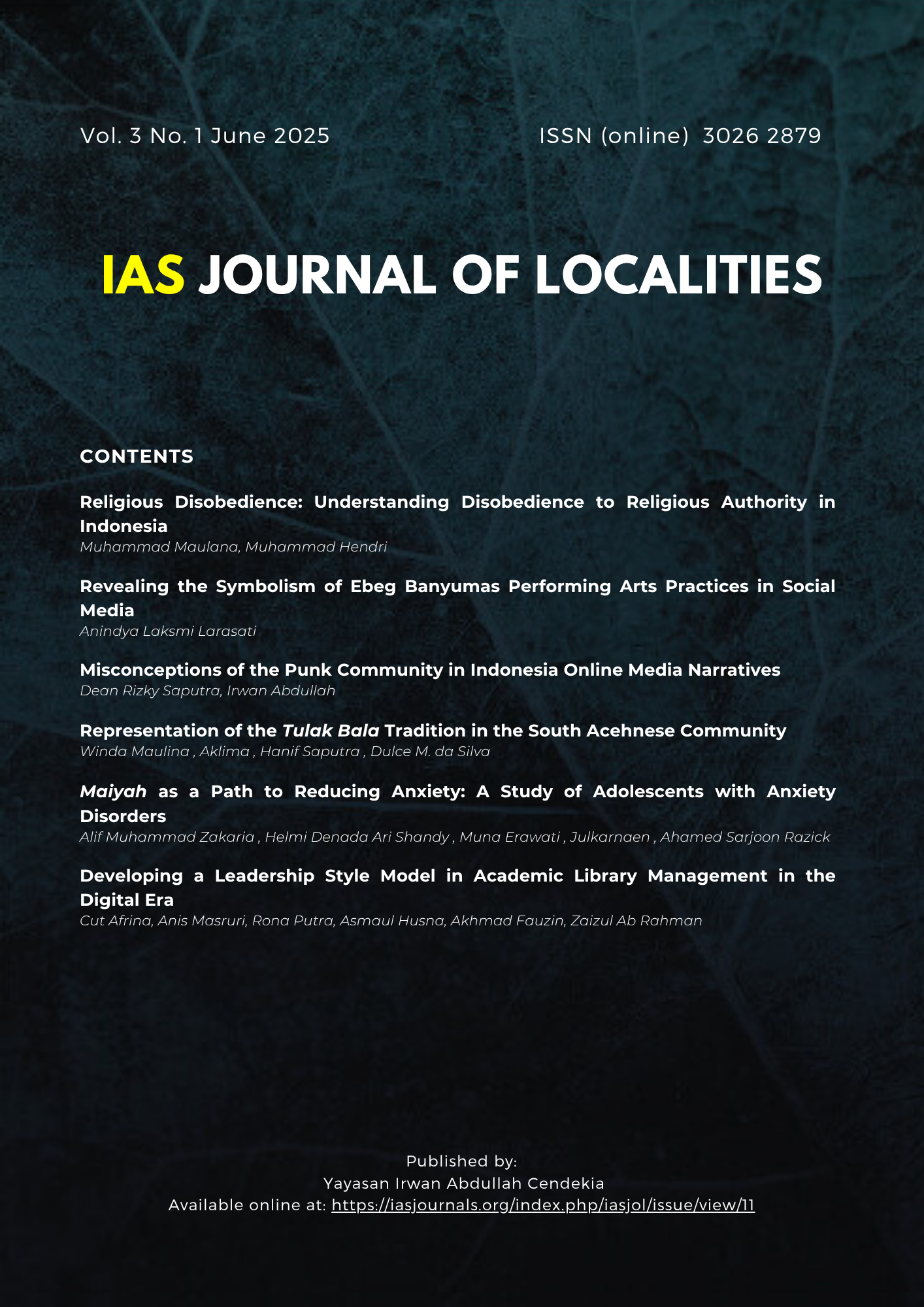
Maiyah as a Path to Reducing Anxiety: A Study of Adolescents with Anxiety Disorders
DOI:
https://doi.org/10.62033/iasjol.v3i1.97Keywords:
Maiyah, Therapy, Psychology, IslamAbstract
Amid the rising prevalence of anxiety disorders among adolescents, the search for alternative approaches beyond conventional medical treatments has become increasingly relevant. Maiyah, a spiritual and cultural forum rooted in the traditions of Indonesia (Islam Nusantara), offers a unique and inclusive approach. This study aims to describe how and why participation in Maiyah activities helps reduce anxiety in Muslim adolescents diagnosed with anxiety disorders. Employing a qualitative method with a phenomenological approach, data were collected through in-depth interviews, observation, and documentation. The findings reveal that adolescent anxiety often begins with loneliness, escalates into psychological pressure, and eventually manifests as anxiety related to economic, career, and future uncertainties. Maiyah plays a significant role in alleviating anxiety through the concept of semeleh—presented in accessible language, practical values for daily life, a familial and open atmosphere, and a deeply spiritual-philosophical framework. These findings underscore the importance of Maiyah as an alternative spiritual space that meaningfully addresses the psychological struggles of contemporary Muslim youth.
References
Abdillah, M., Febriani, F., Asmita, S., & Lusiana. (2023). Transwomen and transmen from Islamic family law perspective. IAS Journal of Localities, 1(1), 67–80. https://doi.org/10.62033/iasjol.v1i1.13
Abdul Rahman, H., Abu Sufian, F., Fauzi, S., Azmi, S., & Abdul Aziz, A. (2019). Prevalence and patient feedback on Islamic spiritual healing in Brunei. Spirituality in Clinical Practice, 6(3), 158–165. https://doi.org/10.1037/scp0000193
Abubakar, A. R., Sani, I. H., Malami, S., Yaro, A. H., Jahan, I., Adnan, N., Kumar, S., Islam, S., Dutta, S., Charan, J., & Haque, M. (2021). Anxiety Disorders: Recent Global Approach to Neuro-pathogenesis, Drug Treatment, Cognitive Behavioral Therapy, and Their Implications. Bangladesh Journal of Medical Science, 20(3), 487–503. https://doi.org/10.3329/bjms.v20i3.52790
Aggarwal, S., Wright, J., Morgan, A., Patton, G., & Reavley, N. (2023). Religiosity and spirituality in the prevention and management of depression and anxiety in young people: a systematic review and meta-analysis. BMC Psychiatry, 23(1), 1–33. https://doi.org/10.1186/s12888-023-05091-2
Ali, T., & Sultan, H. (2023). An Islamic Perspective on Infection Treatment and Wound Healing. Religions, 14(8), 1044. https://doi.org/10.3390/rel14081044
Bentley, J. A., Feeny, N. C., Dolezal, M. L., Klein, A., Marks, L. H., Graham, B., & Zoellner, L. A. (2021). Islamic Trauma Healing: Integrating Faith and Empirically Supported Principles in a Community-Based Program. Cognitive and Behavioral Practice, 28(2), 167–192. https://doi.org/10.1016/j.cbpra.2020.10.005
Bosch, A., Riebschleger, J., & van Loon, L. (2017). Dutch youth of parents with a mental illness reflect upon their feelings of guilt and shame. International Journal of Mental Health Promotion, 19(3), 159–172. https://doi.org/10.1080/14623730.2017.1315955
Bystritsky, A., & Kronemyer, D. (2014). Stress and Anxiety: Counterpart Elements of the Stress/Anxiety Complex. Psychiatric Clinics of North America, 37(4), 489–518. https://doi.org/10.1016/j.psc.2014.08.002
Cahyani, D. F., & Putri, N. S. (2024). Dampak Kecemasan Berlebih Terhadap Psikologis Gen Z (Usia Remaja). Jurnal Psikologi Dan Bimbingan Konseling, 3(3), 82–94. https://doi.org/10.3287/ljpbk.v1i1.325
Chen, Q. (2023). Causes and Treatment of Anxiety Disorder. Lecture Notes in Education Psychology and Public Media, 9(1), 319–324. https://doi.org/10.54254/2753-7048/9/20230230
Chrisanto, I. A. (2024). Liberation Theology in Indonesia: The Role of Cak Nun and Maiyah Community in Social Transformation. Abrahamic Religions: Jurnal Studi Agama-Agama, 4(2), 109–122. https://doi.org/10.22373/arj.v4i2.23663
Creswell, J. W., & Poth, C. N. (2016). Qualitative Inquiry & Research Design: Choosing Among Five Approaches (3rd ed.). Sage Publications, Inc. https://books.google.co.id/books?hl=id&lr=&id=DLbBDQAAQBAJ&oi=fnd&pg=PP1&dq=Qualitative+Inquiry+%26+Research+Design:+Choosing+Among+Five+Approaches&ots=-is2a8MNOw&sig=JzTcJ43KxwVhTSp7-q2JWcTt4Fk&redir_esc=y#v=onepage&q=Qualitative Inquiry %26 Research Design%3A Choosing Among Five Approaches&f=false
Engineer, A. A. (1990). Islam and liberation theology: Essays on liberative elements in Islam. Sterling Publishers. https://ixtheo.de/Record/1602014426
Feldman, J. M. (2020). Achieving Mental Health Equity: Community Psychiatry. Psychiatric Clinics of North America, 43(3), 511–524. https://doi.org/10.1016/j.psc.2020.06.002
Halaby, A., Haddad, R., & Naja, W. (2015). Non-Antidepressant Treatment of Social Anxiety Disorder: A Review. Current Clinical Pharmacology, 10(2), 126–130. https://doi.org/10.2174/15748847113089990059
Hansen, A. S., Telléus, G. K., Mohr-Jensen, C., & Lauritsen, M. B. (2021). Parent-perceived barriers to accessing services for their child’s mental health problems. Child and Adolescent Psychiatry and Mental Health, 15(1), 4. https://doi.org/10.1186/s13034-021-00357-7
Hassan, M. (2024). Finding Peace Islamic Approaches to Managing Stress. Research Journal Ulūm-e-Islāmia, 31(1), 1–11. https://papers.ssrn.com/sol3/papers.cfm?abstract_id=4905710
Hofmann, S. G., Boettcher, H., & Wu, J. Q. (2015). Social Phobia across the Lifespan. In International Encyclopedia of the Social & Behavioral Sciences (pp. 493–499). Elsevier. https://doi.org/10.1016/B978-0-08-097086-8.21016-7
Hukama, A. F. (2017). Persepsi masyarakat pedesaan terhadap pendidikan tinggi (studi analisis teori George Herbert Mead). J-PIPS (Jurnal Pendidikan Ilmu Pengetahuan Sosial), 4(1), 1–13. https://doi.org/10.18860/jpips.v4i1.7298
Ikhwan, M., Walidin, W., & Mahmud, S. (2023). Islamic Education’s Alternative Approach to Nurturing Mental Health and Psychological Well-being. International Journal of Education, Language, and Social Science, 1(1), 12–25. https://doi.org/10.62612/ijelass.v1i1.5
Kessler, R. C., Ruscio, A. M., Shear, K., & Wittchen, H.-U. (2009). Epidemiology of Anxiety Disorders. In Behavioral neurobiology of anxiety and its treatment (pp. 21–35). Springer. https://doi.org/10.1007/7854_2009_9
Kühl, J., & Firk, C. (2025). Sensory Processing Sensitivity – Significance of the Trait for Diagnostics and Psychotherapy with Children and Adolescents. Praxis Der Kinderpsychologie Und Kinderpsychiatrie, 74(1), 61–82. https://doi.org/10.13109/prkk.2025.74.1.61
Laksmiwati, E. D., & Tondok, M. S. (2023). Perceived Social Support, Academic Self-Efficacy, and Anxiety among Final Year Undergraduate Students: A Mediation Analysis. Bulletin of Counseling and Psychotherapy, 5(2), 173–182. https://doi.org/10.51214/00202305514000
Lang, M., Krátký, J., & Xygalatas, D. (2020). The role of ritual behaviour in anxiety reduction: an investigation of Marathi religious practices in Mauritius. Philosophical Transactions of the Royal Society B: Biological Sciences, 375(1805), 20190431. https://doi.org/10.1098/rstb.2019.0431
Lincoln, Y. S., & Guba, E. G. (1985). Naturalistic Inquiry. SAGE Publication Ltd. https://books.google.co.id/books?id=2oA9aWlNeooC&printsec=frontcover&hl=id&source=gbs_ge_summary_r&cad=0#v=onepage&q&f=false
Maktar, A., Mohamed Sidik, M. S., Yahya, F., & Awang, A. (2025). Self-compassion from an Islamic lens: fostering mental well-being. Journal of Spirituality in Mental Health, 1–26. https://doi.org/10.1080/19349637.2025.2473048
Ministry of Health of the Republic of Indonesia. (2018). Laporan Nasional Riskesdas 2018. https://repository.badankebijakan.kemkes.go.id/id/eprint/3514/
Mitha, K. (2019). Sufism and healing. Journal of Spirituality in Mental Health, 21(3), 194–205. https://doi.org/10.1080/19349637.2018.1464423
Moleong, L. J. (2014). Metode Penelitian Kualitatif (Edisi Revisi). PT. Remaja Rosdakarya.
Morales-Muñoz, I., Mallikarjun, P. K., Chandan, J. S., Thayakaran, R., Upthegrove, R., & Marwaha, S. (2023). Impact of anxiety and depression across childhood and adolescence on adverse outcomes in young adulthood: a UK birth cohort study. The British Journal of Psychiatry, 222(5), 212–220. https://doi.org/10.1192/bjp.2023.23
Mujib, A. (2015). Pendekatan Fenomenologi Dalam Studi Islam. Jurnal Pendidikan Islam, 6(2), 167–183. https://ejournal.radenintan.ac.id/index.php/tadzkiyyah/article/view/1485
Nia, K., & Mubaedi, I. (2018). Konsep Pendidikan Multikultural Menurut Caknun (Studi atas Jamaah Maiyah Cak Nun). Jurnal Keislaman Dan Kemasyarakatan, 2(2), 160–182. https://ejournal.kopertais4.or.id/madura/index.php/aliman/article/view/3282
Pérez, J. C., Cumsille, P., & Martínez, M. L. (2016). Brief report: Agreement between parent and adolescent autonomy expectations and its relationship to adolescent adjustment ☆. Journal of Adolescence, 53(1), 10–15. https://doi.org/10.1016/j.adolescence.2016.08.010
Pertiwi, G. A. (2020). Pengaruh Stres Akademik dan Manajemen Waktu Terhadap Prokrastinasi Akademik. Psikoborneo: Jurnal Ilmiah Psikologi, 8(4), 738–749. https://doi.org/10.30872/psikoborneo.v8i4.5578
Pfeifer, J. H., & Allen, N. B. (2021). Puberty Initiates Cascading Relationships Between Neurodevelopmental, Social, and Internalizing Processes Across Adolescence. Biological Psychiatry, 89(2), 99–108. https://doi.org/10.1016/j.biopsych.2020.09.002
Rahman, M. T. (2015). Health and healing in Islam: links and gaps with (post)modern practices. Bangladesh Journal of Medical Science, 14(2), 119–129. https://doi.org/10.3329/bjms.v14i2.21808
Rayan, A., Harb, A. M., Baqeas, M. H., Al.Khashashneh, O. Z., & Harb, E. (2022). The Relationship of Family and School Environments with Depression, Anxiety, and Stress Among Jordanian Students: A Cross-Sectional Study. SAGE Open Nursing, 8, 23779608221138430. https://doi.org/10.1177/23779608221138432
Robingatun, Astuti, F., & Wasik, A. (2024). Sufism Revisited: A Comprehensive Analysis of Emha Ainun Najib’s Philosophical Contributions to Modern Society. Journal of Islamic Thought and Civilization, 14(1), 352–371. https://doi.org/10.32350/jitc.141.21
Romeo, R. D. (2017). The impact of stress on the structure of the adolescent brain: Implications for adolescent mental health. Brain Research, 1654, 185–191. https://doi.org/10.1016/j.brainres.2016.03.021
Sachdeva, G. (2024). Contribution of Religion and Spirituality in the Wellbeing of Individuals. In New Approaches to the Scientific Study of Religion (pp. 263–274). https://doi.org/10.1007/978-3-031-67360-3_23
Sajadian, M., Younesi, S. J., Jafari, P., Azkhosh, M., Yarandi, R. B., & Kordbagheri, M. (2024). Shame, fear of compassion, self-criticism, and self-reassurance mediate the effect of early life events on emotional disorders among male prisoners: A structural equation modeling analysis. Acta Psychologica, 242, 104116. https://doi.org/10.1016/j.actpsy.2023.104116
Sawyer, S. M., Azzopardi, P. S., Wickremarathne, D., & Patton, G. C. (2018). The age of adolescence. The Lancet Child & Adolescent Health, 2(3), 223–228. https://doi.org/10.1016/S2352-4642(18)30022-1
Semrau, M., Gronholm, P. C., Eaton, J., Maulik, P. K., Ayele, B., Bakolis, I., Mendon, G. B., Bhattarai, K., Brohan, E., Cherian, A. V., Daniel, M., Girma, E., Gurung, D., Hailemariam, A., Hanlon, C., Healey, A., Kallakuri, S., Li, J., Loganathan, S., … Votruba, N. (2024). Reducing stigma and improving access to care for people with mental health conditions in the community: protocol for a multi-site feasibility intervention study (Indigo-Local). International Journal of Mental Health Systems, 18(1), 35. https://doi.org/10.1186/s13033-024-00649-3
Sharaf Eldin, N., Mohamed, N. F., Farrag, N. S., & Elsheikh, E. I. (2025). The Effect of Civic Engagement on Mental Health and Behaviors among Adolescents. Medicine Updates, 76–92. https://doi.org/10.21608/muj.2025.348094.1197
Sheharbano, & Ahmad, A. (2013). Relationship Between Religious / Spiritual Practices and Physical and Mental Health. Sci. Tech. and Dev, 33(1), 34–42. https://www.researchgate.net/publication/263973075_Relationship_Between_Religious_Spiritual_Practices_and_Physical_and_Mental_Health
Sivolap, Y. P., & Azimova, Y. E. (2020). Anxiety in neurological practice. Zhurnal Nevrologii i Psikhiatrii Im. S.S. Korsakova, 120(5), 165–170. https://doi.org/10.17116/jnevro2020120051165
Sofian, A., & Atmaja, K. (2023). Religious Moderation in Virtual Public Sphere (Study of Jamaah Maiyah Gambang Syafaat). In Atlantis Press SARL (pp. 168–170). https://doi.org/10.2991/978-2-38476-174-6_28
Sönmez, D., Avcı, İ. K., & Hocaoglu, C. (2022). A Rare Known Specific Phobia “Turophobia”: A Case Report. Eastern Journal Of Medicine, 27(4), 668–671. https://doi.org/10.5505/ejm.2022.89577
Stewart, W. C., Wetselaar, M. J., Nelson, L. A., & Stewart, J. A. (2019). Review of the Effect of Religion on Anxiety. International Journal of Depression and Anxiety, 2(2), 1–5. https://doi.org/10.23937/2643-4059/1710016
Sugiyono. (2017). Metode Penelitian Kuantitatif, Kualitatif, dan R&D. CV. Alvabeta.
Suhami, N., Muhamad, M. B., & Krauss, S. E. (2016). Why Cancer Patients Seek Islamic Healing. Journal of Religion and Health, 55(5), 1507–1518. https://doi.org/10.1007/s10943-015-0114-6
Syam, R., Saleh, A., Purwita, I., Mawandani, N. W., Mayangsari, P., & Maharani, S. (2021). Program Kesehatan Mental “Taking Care of Your Mental Health and Those Around You” Berbasis Online sebagai Upaya Peningkatan Pemahaman Kesehatan Mental Masyarakat. Pengabdi, 2(2), 160–167. https://doi.org/10.26858/pengabdi.v2i2.24971
Tabei, S. Z., Zarei, N., & Joulaei, H. (2016). The Impact of Spirituality on Health. Shiraz E-Medical Journal, 17(6), 1–6. https://doi.org/10.17795/semj39053
Teleanu, R. I., Niculescu, A.-G., Roza, E., Vladâcenco, O., Grumezescu, A. M., & Teleanu, D. M. (2022). Neurotransmitters—Key Factors in Neurological and Neurodegenerative Disorders of the Central Nervous System. International Journal of Molecular Sciences, 23(11), 5954. https://doi.org/10.3390/ijms23115954
Torales, J., Aveiro-Róbalo, T. R., Ríos-González, C., Barrios, I., Almirón-Santacruz, J., González-Urbieta, I., Caycho-Rodríguez, T., Castaldelli-Maia, J. M., & Ventriglio, A. (2023). Discrimination, stigma and mental health: what’s next? International Review of Psychiatry, 35(3–4), 242–250. https://doi.org/10.1080/09540261.2023.2186218
Verisa, G. S., Mutmainah, N., Fidyastuti, N., & Minsih, M. (2024). Improving the Creativity of Children with Disabilities Based on Local Culture: An Exploration of the “Karya.Ku” Program. IAS Journal of Localities, 2(2), 172–183. https://doi.org/10.62033/iasjol.v2i2.75
Widiani, E., Hidayah, N., & Hanan, A. (2023). Anxiety, Depression, Loneliness, Spirituality, and Social Support in Older People During the COVID-19 Pandemic. Jurnal Keperawatan Indonesia, 26(2), 79–88. https://doi.org/10.7454/jki.v26i2.1093
Downloads
Submitted
Accepted
Published
How to Cite
Issue
Section
License
Copyright (c) 2025 Alif Muhammad Zakaria, Helmi Denada Ari Shandy, Muna Erawati, Julkarnaen, Ahamed Sarjoon Razick

This work is licensed under a Creative Commons Attribution 4.0 International License.